
Thousand Oaks
The Berkeley neighborhood that families research for months and rarely reconsider.
The Thousand Oaks Neighborhood
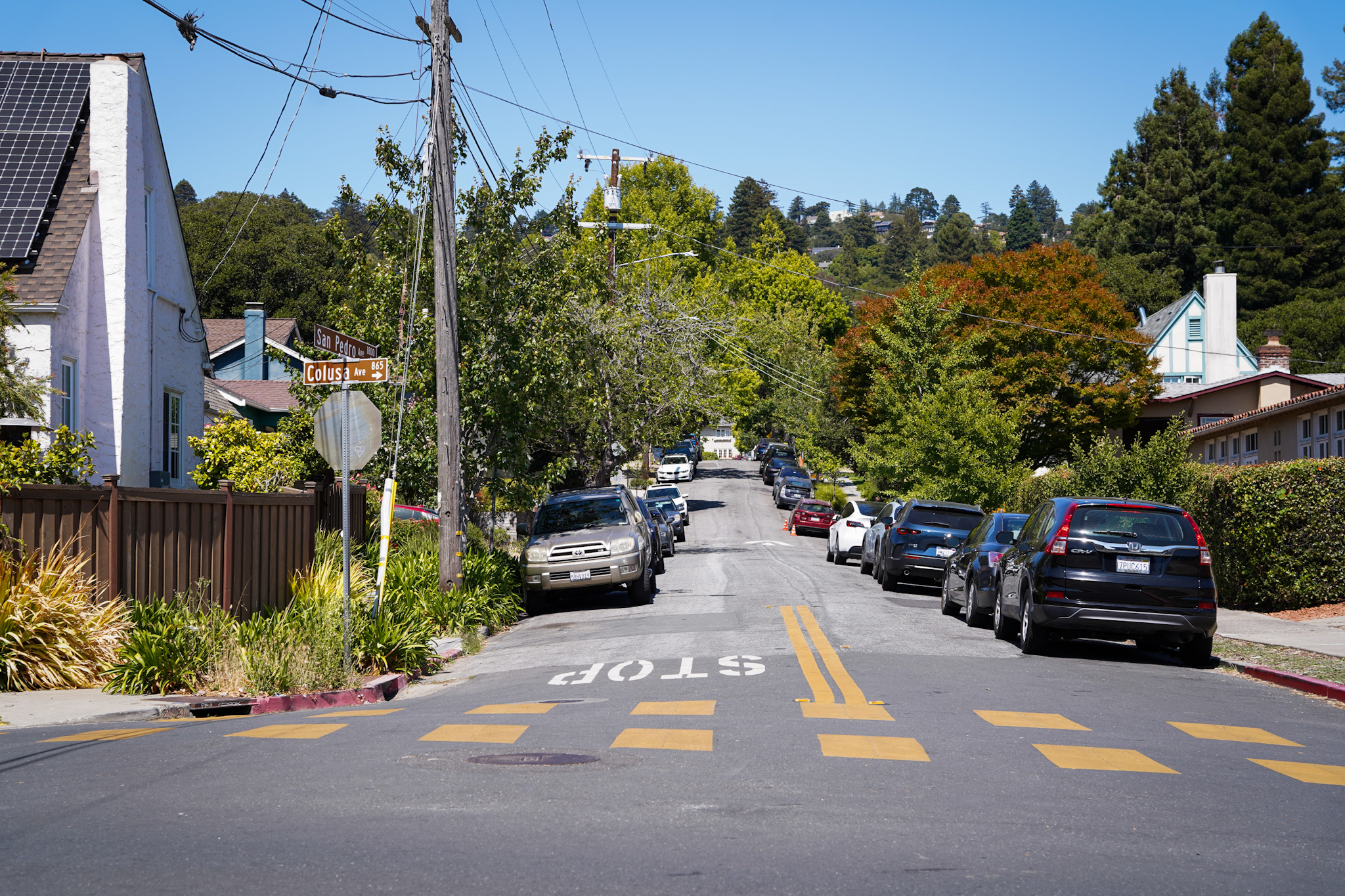
Thousand Oaks occupies a compact and distinctive swath of north Berkeley between Solano Avenue to the south, Thousand Oaks Boulevard to the north, Santa Fe Avenue to the west, and Arlington Avenue to the east. It is a neighborhood that announces itself physically — its streets were designed in the early twentieth century to wind deliberately around outcroppings of granite boulders rather than cut through them, producing a residential landscape unlike anything else in Berkeley. The mature oaks that give the neighborhood its name form a continuous canopy over streets that feel almost rural in their quiet, despite sitting within blocks of one of the most vibrant commercial corridors in the East Bay.
The neighborhood’s housing stock reflects two distinct eras of development. The earliest homes, built in the first decade of the twentieth century, are Craftsman bungalows and shingled lodges that reflect the Arts and Crafts values then dominant in Berkeley residential design. A second wave of construction, much of it following the catastrophic 1923 fire that burned through the hills to the south, brought the Spanish Colonial, Tudor, and French Provincial period revival homes that now characterize much of the neighborhood — stucco and tile replacing the combustible wood shingles of the earlier era. John Hudson Thomas, Berkeley’s most prolific residential architect of the period, has a significant concentration of documented work in Thousand Oaks, and his houses — identifiable by their complex massing and sophisticated surface treatment — appear throughout the neighborhood’s streets.
Thousand Oaks is among the most consistently competitive neighborhoods in Berkeley, and for reasons that are specific and durable rather than fashionable. The combination of quiet, boulder-lined streets, larger lots than most of the flatlands, Bay views from the upper reaches near Arlington, proximity to Solano Avenue’s shops and restaurants, and access to one of Berkeley Unified’s most sought-after elementary schools creates a neighborhood identity that buyers actively seek rather than stumble upon. The families who end up in Thousand Oaks have almost always specifically targeted it — and that concentration of intentional demand keeps the market tight year after year.
Megan’s take
“Thousand Oaks buyers are among the most prepared I work with. By the time they call me, they have usually spent months researching the neighborhood — they know the schools, they know the streets, and they know exactly why they want to be here rather than somewhere else in Berkeley. What surprises them is how rarely homes come to market, and how quickly they move when they do. The streets that wind around the granite boulders in the upper reaches are genuinely unlike anything else in the city.”
What is daily life like in Thousand Oaks

Solano Florist, Thousand Oaks neighborhood
The center of daily life in Thousand Oaks is Solano Avenue, the commercial corridor that runs along the neighborhood’s southern edge and doubles as the Berkeley-Albany border. Solano is a genuinely local street — a mix of independent restaurants, cafes, bookshops, hardware stores, and neighborhood businesses that serves residents rather than tourists. The Solano Stroll, the neighborhood’s annual street festival held every September, closes the avenue to traffic and draws tens of thousands of people from across the East Bay, and has been doing so since 1974. It is the kind of civic tradition that tells you something real about a community.
For groceries, Andronico’s on Solano is the primary neighborhood anchor, supplemented by the short trip to Monterey Market on Hopkins for produce. The Hopkins Street shopping district in adjacent Northbrae — with its cluster of specialty food shops, cafes, and the beloved Acme Bread and Cheeseboard outlets nearby — extends the daily convenience further. Coffee is a short walk in either direction. The neighborhood’s street life is quieter than North Berkeley’s, which is precisely what most Thousand Oaks buyers are looking for — the ability to reach everything without living inside the commercial activity.
The physical character of the neighborhood is itself a daily amenity. The landscaped median strips, the winding streets around granite boulders, and the mature tree canopy give Thousand Oaks a quality that residents describe as almost countryside-like for an urban address. Weekend mornings here tend to involve the kind of unhurried neighborhood life — people on their porches, dogs on the sidewalks, children on bikes — that has become increasingly rare in Bay Area cities at this price point.
What schools serve Thousand Oaks

Parks and outdoor life in Thousand Oaks
Thousand Oaks Park, on The Alameda near the heart of the neighborhood, provides the primary local green space — a well-maintained neighborhood park with a children’s play area, open lawn, and the kind of quiet, local-use character that reflects the surrounding residential streets. It draws a consistent daily population of families and dog owners from the surrounding blocks.
The neighborhood’s larger outdoor asset is its immediate proximity to Tilden Regional Park in the Berkeley Hills. From the upper reaches of Thousand Oaks near Arlington Avenue, the park is accessible within minutes, opening onto more than 39 miles of multi-use trails for hiking, cycling, and running, the Tilden Nature Area, Lake Anza for summer swimming, and Inspiration Point with panoramic Bay and Golden Gate views. For buyers who prioritize outdoor access, the combination of a quiet residential neighborhood and immediate trail access at this price point is genuinely difficult to find elsewhere in the East Bay. The Tilden Little Farm — a beloved free destination for families with young children — is a short drive from most Thousand Oaks addresses.
Getting around from Thousand Oaks
Thousand Oaks is primarily a car and bicycle neighborhood. There is no BART station within easy reach — the closest is North Berkeley BART on Sacramento Street, approximately ten minutes by car or bicycle from most addresses. AC Transit’s 67 line runs along Arlington Avenue and connects to Downtown Berkeley and the UC campus, and several lines serve the Solano Avenue corridor. For buyers commuting to San Francisco on a daily basis, Thousand Oaks works best with a car or an e-bike and a willingness to drive or ride to BART.
Highway 24 is accessible via Tunnel Road through the Claremont neighborhood, providing access to Contra Costa County, the 680 corridor, and points east. Interstate 80 is reachable via University Avenue. Solano Avenue itself connects directly to Albany and El Cerrito to the north. The neighborhood’s relative distance from BART is a known tradeoff that most Thousand Oaks buyers have already made peace with before they begin their search — the neighborhood’s other qualities make the commute calculus work for the buyers who choose it.
Thousand Oaks neighborhood map

Thinking about Thousand Oaks?
I’ve represented buyers and sellers throughout this neighborhood for years. If you’d like a candid conversation about what’s available and what to expect, I’m always glad to talk.
Frequently asked questions about Thousand Oaks
Thousand Oaks Resources
Thousand Oaks resources
Links open in a new window. If you find a broken link, let us know.