
Northbrae
Quiet streets, legendary markets, and a rock with a world-class view.
The Northbrae Neighborhood
Northbrae occupies a compact and carefully planned section of north Berkeley, bounded by Solano Avenue to the north, Gilman Street and Hopkins Street to the south, Peralta Avenue to the west, and Sutter Street to the east. It was developed beginning in the early twentieth century by Duncan McDuffie and Joseph Mason of Mason-McDuffie Co., who purchased approximately 700 acres following the influx of San Franciscans arriving in the East Bay after the 1906 earthquake. McDuffie envisioned a park-like neighborhood of single-family houses designed around a deliberate principle: every lot would be convenient to rail transit, and the street pattern would flow north and south to give most homes views of both San Francisco Bay and the Berkeley hills. The result is a neighborhood with curved streets that follow the natural contours of the terrain, landscaped medians, and an unusual sense of width and openness that most Berkeley residential streets simply do not have.
The neighborhood’s physical character was shaped from the beginning by its geology. The volcanic rock outcroppings visible throughout Northbrae — including Indian Rock itself — are Northbrae rhyolite, a composite rock with high quartz content deposited by eruptions nine to eleven million years ago and give the district its name. This material appears not only in its natural formation but throughout the neighborhood in garden walls and design elements, giving Northbrae a geological distinctiveness no other Berkeley neighborhood shares. The stone pillars identifying each street — named for California counties — were designed by UC Berkeley architect John Galen Howard, giving the neighborhood a unified civic infrastructure from its earliest days. Fountain Circle, built in 1911 with a classical balustrade and a fountain featuring four grizzly bear cubs by renowned animal sculptor Arthur Putnam, completed the original civic vision. Destroyed in a 1958 vehicle accident, the fountain was restored in 1996 through a community fundraising effort that raised over $100,000.
The housing stock reflects the two main waves of development that followed. The oldest homes are Craftsman and California bungalows built in the first decade of the twentieth century, designed to blend with the hillsides and incorporate the rhyolite outcroppings into their sites. A second wave through the 1920s and 1930s brought the Period Revival homes — Spanish Colonial, Tudor, and French Provincial — that give many of the neighborhood’s streets their current character, alongside Colonial Revival homes with symmetrical facades and formal entries. Northbrae is not Thousand Oaks, and it does not try to be. It is a neighborhood of genuine practical virtue: well-connected to BART, anchored by the Monterey Market, one of the finest produce markets in the Bay Area, bordered by Solano Avenue’s shops and restaurants, and home to outdoor spaces that consistently surprise visitors with their integrated geology.
Megan’s take
“Northbrae attracts buyers who value nature, community, and convenience. Everyone knows about Thousand Oaks and North Berkeley, but Northbrae often surprises people — the streets are wider, the parks are more plentiful than they expect, and the access to Monterey Market and the Hopkins corridor is genuinely unbeatable for daily life. The moment that usually seals it is when I take buyers to Indian Rock for the first time. They’re expecting a neighborhood park and they get a 360-degree panorama of the Bay. That tends to end the conversation about whether Northbrae is worth considering.”
What is daily life like in Northbrae

The center of daily life in Northbrae is Hopkins Street, the commercial strip that runs along the neighborhood’s southern edge and concentrates an unusually good selection of neighborhood businesses in a short stretch. Monterey Market, at the corner of Hopkins and Monterey Avenue, is the neighborhood’s most celebrated institution — a family-owned produce market operating since 1961 that consistently offers the best seasonal produce selection in Berkeley at prices that put most grocery stores to shame. On any given morning the market draws a cross-section of the neighborhood that no other institution could assemble: chefs, home cooks, neighbors running errands, and people who drove across the city specifically for the persimmons or the dry-farmed tomatoes. Fish and poultry markets, a bakery, and specialty shops fill the blocks around Monterey Market along the Hopkins corridor.
Solano Avenue, along the neighborhood’s northern edge on the Albany border, provides a second commercial layer with a more varied restaurant and retail offering and the kind of pedestrian energy that makes Saturday errands feel more social than transactional. The Solano Avenue Association’s annual Solano Stroll, held every September since 1974, closes the avenue to traffic and draws an estimated 250,000 attendees — a civic tradition that reflects how deeply the street anchors community life in this part of north Berkeley.

The Fountain Walk, which once connected Fountain Circle to the neighborhood’s original rail station, now forms part of Berkeley’s broader path and stairway network, threading through the neighborhood and linking it to the wider system of 136 public paths and steps that crisscross the city. The North Branch Berkeley Public Library at Hopkins and The Alameda — a 1936 Spanish Revival building designed by James W. Plachek with a low-pitched red tile roof, central tower, and deeply inset arched windows — serves as both a neighborhood gateway and a genuine community anchor for residents of all ages.
What schools serve Northbrae
Northbrae falls within the Northwest Zone of the Berkeley Unified School District lottery system, which includes Berkeley Arts Magnet, Ruth Acty, Rosa Parks, and Thousand Oaks elementary schools. Zone assignment determines which schools a family can be considered for, but the specific school is allocated by lottery rather than by proximity or address. Middle school students in the Northwest Zone typically attend King Middle School, located on the neighborhood’s southern edge — which hosts the Edible Schoolyard, Alice Waters’ one-acre student-farmed garden that draws more than 1,000 visitors annually and represents the same farm-to-table values that define Berkeley’s broader food identity. All BUSD students attend Berkeley High School for grades 9 through 12.
School assignments in Berkeley are address-specific and subject to periodic revision. I always recommend verifying the current assignment directly with BUSD before making decisions based on school access, and I am glad to help with that for any specific address you are considering.
Parks and outdoor life in Northbrae
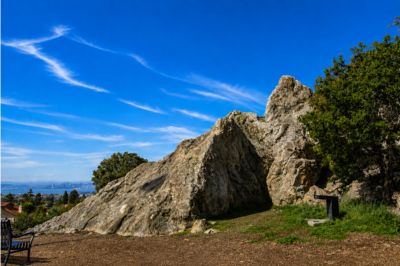
Indian Rock Park is Northbrae’s most distinctive outdoor asset and one of Berkeley’s best-kept neighborhood secrets. The park is built around a massive Northbrae rhyolite outcropping that rises dramatically from the surrounding residential streets on Indian Rock Avenue — the same volcanic rock found throughout the neighborhood, here at its most spectacular. It is a free-climb destination drawing Bay Area climbers of all levels, with views from the top that span San Francisco Bay, the Golden Gate Bridge, the Marin headlands, and the Berkeley hills in a 360-degree panorama that is among the finest in the city. The park was donated to the city by Mason-McDuffie Co. as part of the original neighborhood development. Dogs are welcome. The Indian Rock path links the park directly to the Upper Solano Avenue commercial area — a connection most visitors don’t know exists but that residents use as part of their daily routines.
King School Park, adjacent to King Middle School on the neighborhood’s southern edge, serves as Northbrae’s primary neighborhood park — a full-service outdoor space with a track and field that hosts regular soccer matches, a swimming pool, tennis courts, and a children’s play area. Its proximity to the school gives it a natural dual life: a campus facility during the week and a neighborhood park in the evenings and on weekends, drawing families from the surrounding residential streets throughout the year.
Getting around from Northbrae
The North Berkeley BART station on Sacramento Street and Delaware Avenue is approximately ten minutes on foot from most Northbrae addresses — close enough that many residents walk to BART as part of their daily routine. The station offers direct service to downtown San Francisco (approximately 30 to 35 minutes), Oakland, and the broader BART network. This proximity, more than any other single feature, distinguishes Northbrae from Thousand Oaks in practical terms: buyers who need reliable BART access find Northbrae meaningfully easier to live in for transit-dependent commutes.
The Ohlone Greenway, a five-mile multi-use path running through Berkeley, Albany, El Cerrito, and Richmond alongside the BART tracks, passes through the western edge of Northbrae and provides a car-free cycling route that connects the neighborhood to the station and continues north through Albany into El Cerrito and Richmond. Two bicycle boulevards run south from Northbrae through the city, and three neighborhood streets have dedicated bicycle lanes — infrastructure that reflects the neighborhood’s original design intention of providing multiple ways to move through it without a car. AC Transit serves the Solano Avenue and San Pablo Avenue corridors with additional bus connections to the broader East Bay network.
For drivers, San Pablo Avenue provides direct access north to Albany, El Cerrito, and Richmond, and south to Emeryville and the freeway network. Interstate 80 is accessible via several routes through the flatlands below.
Northbrae neighborhood map

Thinking about Northbrae?
I’ve represented buyers and sellers throughout this neighborhood for years. If you’d like a candid conversation about what’s available and what to expect, I’m always glad to talk.
Frequently asked questions about Northbrae
Northbrae Resources
Northbrae resources
Links open in a new window. If you find a broken link, let us know.