
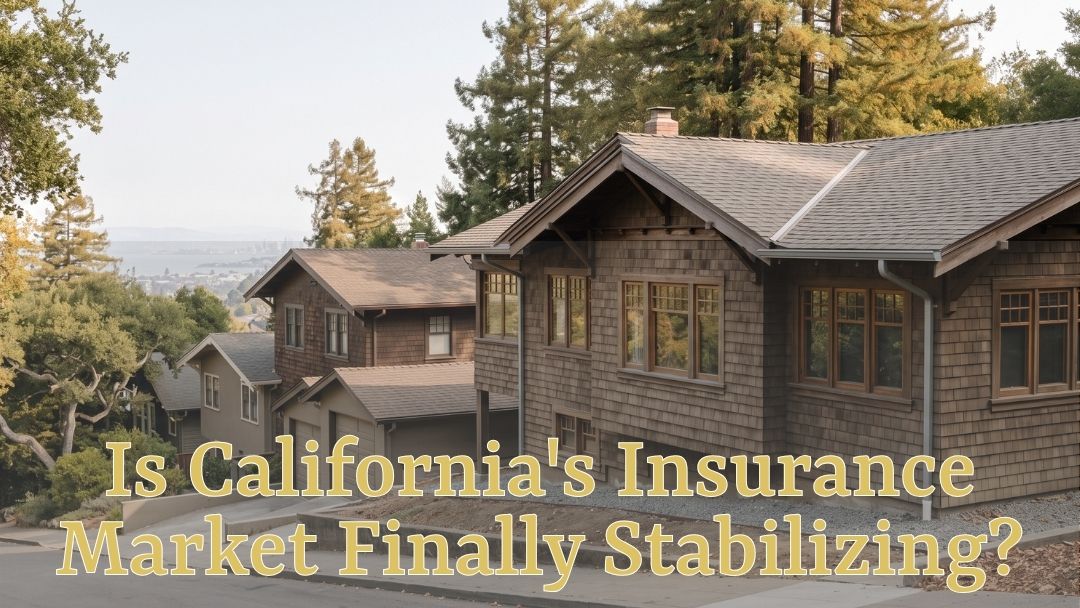
The California homeowners insurance market has begun to stabilize, but this is not the same as being fixed, and the Berkeley hills remain one of the harder places in the state to insure. On August 19 I sat in on From Crisis to Stabilization, a statewide market update from the California Department of Insurance (CDI) featuring Insurance Commissioner Ricardo Lara, economist Carolyn Kousky of Insurance for Good, and Amy Bach of United Policyholders. Below I walk through what has changed, what the FAIR Plan’s own ZIP-code data shows about our neighborhoods, and what is worth doing before an October rate change takes effect (more on that below).
What actually broke in California’s insurance market?
The market did not break because of one fire. It broke because two consecutive wildfire seasons erased decades of accumulated profit. Consulting firm Milliman found that the 2017 and 2018 seasons together wiped out roughly twice the combined underwriting profits California homeowners insurers had earned over the preceding 26 years.
Carriers responded the way carriers do: they stopped writing new business in high-hazard areas, non-renewed existing policyholders, and in some cases left the state entirely. The California FAIR Plan, the state’s insurer of last resort, absorbed the overflow. The California Policy Lab counted about 202,000 FAIR Plan policies in 2020 growing past 441,000 by 2024. By June 30, 2026 the FAIR Plan reported 696,562 policies in force and $768 billion in exposure, up roughly 250% since September 2022.
Kousky’s framing is the one I keep returning to: California has two insurance markets now. In most of the state, competition is reasonably healthy and the FAIR Plan is a genuine last resort. In a concentrated set of high-hazard ZIP codes, the FAIR Plan has effectively become the primary market. The Policy Lab identified 36 ZIP-code areas where FAIR Plan share exceeds 50%, and six where it reaches 75% or more.
How much of this landed in Berkeley?
More than most Berkeley homeowners realize, and it is not confined to the hills. The FAIR Plan publishes policy counts by ZIP code once a year, and the local trend across four fiscal years (each ending September 30) is stark:
| Berkeley ZIP code | 2021 | 2025 | Change |
|---|---|---|---|
| 94708 (hills, Cragmont and La Loma) | 106 | 691 | +552% |
| 94705 (Claremont and Elmwood) | 69 | 451 | +554% |
| 94707 (Westbrae and Thousand Oaks) | 18 | 376 | +1,989% |
| 94703 (Central Berkeley) | 27 | 124 | +359% |
| 94709 (Northside) | 14 | 86 | +514% |
| 94710 (West Berkeley flats) | 25 | 41 | +64% |
Read the bottom row against the top and you have the shape of the problem. The West Berkeley flats added sixteen FAIR Plan policies in four years. The hills added 585. The number I did not expect is 94707, which covers Westbrae and Thousand Oaks and climbs only partway toward Grizzly Peak Blvd, and which went from 18 policies to 376. The line insurers are drawing has moved downhill from where most people assume it sits.
Two caveats on that table. These are raw policy counts rather than market share, because the FAIR Plan does not publish housing-unit totals by ZIP code, and several of these ZIPs straddle the hills and the flats, so the geography is blurrier than the boundaries suggest. Also, these figures only run through September 30, 2025, which is the most recent ZIP-level release.
None of this is chiefly about recent fires. It is about October 20, 1991, when the Tunnel Fire burned 1,520 acres of hillside and destroyed 3,469 living units, killed 25 people, and caused $1.537 billion in losses. The catastrophe models underwriters use read our hills as what they are: a wildland-urban interface with dense, aging housing stock and narrow evacuation routes. One piece of local nuance: While CAL FIRE’s 2025 Fire Hazard Severity Zone maps actually shrank high-hazard acreage in the urban East Bay hills, Berkeley chose to designate additional local high-hazard areas anyway.
Is the Sustainable Insurance Strategy working?
Over the past several years, the CDI has deployed what it calls a Sustainable Insurance Strategy. The strategy is effectively a trade. Insurers got two things they had wanted for years: permission to use forward-looking catastrophe models in ratemaking, and the ability to include the net cost of reinsurance in California rates. In exchange, an insurer using those tools must write policies covering at least 85% of its statewide market share in wildfire-distressed areas, rising five percentage points a year until it gets there.
As of a July 23, 2026 Department of Insurance alert, 11 homeowners groups and two commercial groups have committed. Farmers joined in May 2026, dropped its monthly cap on new business, and pledged to market to at least 300,000 policyholders in areas where the FAIR Plan had become the only option. MS Transverse was approved as a new entrant in July, and USAA expands statewide in January 2027.
The clearest signal that the strategy is working to expand coverage options in California is the FAIR Plan’s growth rate, which slowed to about 16,000 residential policies in the first quarter of 2026 from 35,000 to 50,000 per quarter through much of 2024 and 2025. One caution: none of these announcements name Alameda County, and a statewide commitment does not guarantee a carrier will write your particular house in Berkeley. What it may mean is that a broker who had no good options outside of the FAIR Plan in 2024 might have something to offer you now, which is worth a phone call.
Why is my premium still rising if the market is stabilizing?
Because availability and price move on different schedules. Three forces are pushing premiums up regardless of whether carriers are returning.
- The first is the FAIR Plan itself. An average 29.1% rate increase takes effect October 15, 2026, and the FAIR Plan has said higher-risk policyholders will see larger-than-average increases. Berkeley hills homeowners should plan for a number above 30%.
- The second is replacement cost. Your premium reflects what it would cost to rebuild your home, not what you paid for it, and Bay Area construction costs have not come back down. This is the most common gap I find in a policy review, and it is worth reading my longer piece on how to evaluate home insurance in Berkeley before your next renewal.
- The third is reinsurance. California carriers buy their own coverage in a global market that has absorbed record losses worldwide. A hurricane season in Florida can move a premium in the Berkeley hills.
What should Berkeley homeowners do this fall?
Mitigate, document, then ask your insurer in writing what the mitigation is worth. In that order.
The ground shifted on August 19, 2026, when the Board of Forestry and Fire Protection approved California’s first Zone 0 regulations, requiring a five-foot ember-resistant zone around structures for roughly two million homes. The package still needs Office of Administrative Law review, so it is approved but not yet in effect; existing homes will get three years to implement measures for the first phase and five years for phase two.
Berkeley is already ahead of the state here. The city’s EMBER initiative, short for Effective Mitigations for Berkeley’s Ember Resilience, took effect with the local fire code on January 1, 2026, and enforcement began in June with a 60-day correction window before fines. Roughly 1,400 properties in the Grizzly Peak and Panoramic Mitigation Areas are in the first enforced tier, out of more than 9,000 parcels in the broader high-hazard zone. If you own a home east of Grizzly Peak or on Panoramic hill Zone 0 clearance is already a current obligation.
Under the state’s Safer from Wildfires regulation, insurers must offer a discount for each of ten named actions across the structure, the immediate surroundings, and the community. The regulation does not set the size of those discounts, which is why asking your insurance provider for the financial details is important. It also requires your insurer to disclose your property’s wildfire risk score and gives you the right to appeal it, a right almost nobody uses. FAIR Plan policyholders can earn up to twelve Wildfire Hardening Discounts worth as much as 16.4% off the wildfire portion of a dwelling fire premium.
Documentation is what turns any fire mitigation work into actual financial savings: dated before-and-after photographs, contractor invoices, inspection results, and where available an IBHS Wildfire Prepared Home designation. The city of Berkeley can help here. The city runs a free fire fuel chipper program open to any resident, a Defensible Space Resident Assistance Program that clears vegetation at no cost for qualifying households, and counts 21 recognized Firewise USA neighborhoods as of June 2026. Community participation is one of the ten actions, so joining one carries insurance value.
What if no admitted carrier will write a policy for my home?
There are four arrangements, and they are not all equal. Amy Bach laid them out in the webinar in descending order of protection.
- An admitted carrier is the goal: licensed by the Department of Insurance, rates and forms reviewed by the state, and backed by the California Insurance Guarantee Association if the insurer fails.
- A non-admitted or surplus lines carrier has more pricing flexibility and will cover risks admitted carriers will not, but carries no guaranty fund backing, so read the wildfire sub-limits, deductibles, and exclusions closely.
- The FAIR Plan paired with a difference in conditions (DIC) policy is the common hills solution: the FAIR Plan covers fire and a narrow set of perils, and the DIC wrap adds liability, theft, and water damage.
- Force-placed coverage, which your lender buys if your policy lapses, is the outcome to avoid. It is expensive, and it protects the lender rather than you.
Three practical notes. Work with an independent broker rather than a captive agent, who can place you with only one company and will send you to the FAIR Plan if underwriting fails. Raise your deductible if your savings can absorb it. Avoid small claims, since each can affect your risk profile at renewal.
What does this mean if you are buying or selling in Berkeley?
For buyers, get an insurance quote before you submit an offer, not during escrow. Ongoing carrying costs are the part of any home purchase that buyers most often underestimate, but you can definitely estimate them.
For sellers, mitigation now carries a financial return beyond insurability. Berkeley’s Home Hardening Tax Rebate refunds up to one third of the city’s base 1.5% transfer tax for qualifying homes in a High or Very High Fire Hazard Severity Zone selling under $3 million, provided the work was done on or after January 1, 2025 and the property passes a defensible space inspection. It stacks with the seismic transfer tax rebate where a home qualifies for both, and I now build both into the prep conversation for every hills listing, alongside the rest of the Berkeley selling process.
A home with documented five-foot clearance, a Class A roof, and ember-resistant vents is easier for a buyer to insure, and buyers are starting to value that difference. Zone 0 compliance, where required, is becoming a negotiating point, not just a code requirement.
If you want to talk through what any of this means for your own home or timeline, I am glad to model specific scenarios with you. You can reach me at [email protected], at (510) 708-9952, or through my contact page.
Frequently Asked Questions
Common questions about California’s insurance market and what it means in Berkeley
Availability is recovering; price is not, at least not yet. Eleven homeowners insurance groups and two commercial groups have committed to grow in California under the Sustainable Insurance Strategy, new carriers have entered the market, and FAIR Plan growth slowed to roughly 16,000 residential policies in the first quarter of 2026 from 35,000 to 50,000 per quarter in prior years. Premiums are still climbing, because replacement costs and global reinsurance pricing move independently of how many carriers are writing. The reasonable expectation for 2026 and 2027 is more choice at prices that stay high.
The FAIR Plan publishes residential policy counts by ZIP code once a year, and as of September 30, 2025 the Berkeley numbers were 691 policies in 94708 (the hills), 451 in 94705 (Claremont and Elmwood), 376 in 94707 (Westbrae and Thousand Oaks), 133 in 94704, 124 in 94703, 86 in 94709, 67 in 94702 and 41 in 94710 (the West Berkeley flats). Four years earlier, 94708 had 106 and 94707 had 18. These are raw policy counts rather than a share of homes, since the FAIR Plan does not publish housing-unit totals by ZIP code.
The Sustainable Insurance Strategy is the Department of Insurance’s package of regulatory changes intended to bring insurers back to high-risk areas. It lets carriers use forward-looking catastrophe models in ratemaking and include the net cost of reinsurance in California rates, two things the industry had sought for years. In exchange, any insurer using those tools must write policies covering at least 85% of its statewide market share in wildfire-distressed areas, increasing by five percentage points annually until it reaches that level. The Department can enforce those commitments, which is a power no other state has.
If your property sits in Berkeley’s High or Very High Fire Hazard Severity Zone, yes, and the local requirement arrived before the state one. Berkeley’s EMBER requirements took effect with the city’s fire code on January 1, 2026, and enforcement began in June 2026 with a 60-day window to correct violations before fines. Roughly 1,400 properties in the Grizzly Peak and Panoramic Mitigation Areas are in the first enforced tier, out of more than 9,000 parcels in the broader zone. The statewide Zone 0 regulation was approved on August 19, 2026 and is pending final administrative review.
It can, though the amount varies by insurer and is not guaranteed. California’s Safer from Wildfires regulation requires insurers to offer a discount for each of ten mitigation actions across the structure, the immediate surroundings, and the community, but it does not set how large those discounts must be. That is why documentation and a direct written request matter more than the work alone. The same regulation requires your insurer to disclose your property’s wildfire risk score and gives you the right to appeal it, which is worth doing if the score looks wrong for your parcel.
Because availability and price respond to different pressures. Three forces are pushing California premiums up regardless of how many carriers are writing new business: the FAIR Plan’s average 29.1% rate increase effective October 15, 2026, which falls hardest on high-wildfire-risk policyholders; replacement cost, since your premium reflects what it would cost to rebuild rather than what you paid, and Bay Area construction costs have not receded; and reinsurance, which California carriers buy in a global market that has absorbed record catastrophe losses worldwide.
The California Department of Insurance runs a consumer hotline at 1-800-927-4357 that handles non-renewal questions and complaints, and it publishes the list of active one-year non-renewal moratoriums issued after declared wildfire emergencies. United Policyholders, a nonprofit consumer organization, maintains a California insurance help hub and a WRAP Resource Center with county-specific guidance on mitigation, inspections, and shopping for coverage. Neither charges homeowners anything. Locally, Berkeley’s Fire Department Wildfire Division can confirm your zone designation and inspection status, which insurers frequently ask about.
This information is general and reflects conditions as of August 2026. Insurance rules, rates, and compliance deadlines change, so please verify current details with your broker or the California Department of Insurance before making a decision.


