
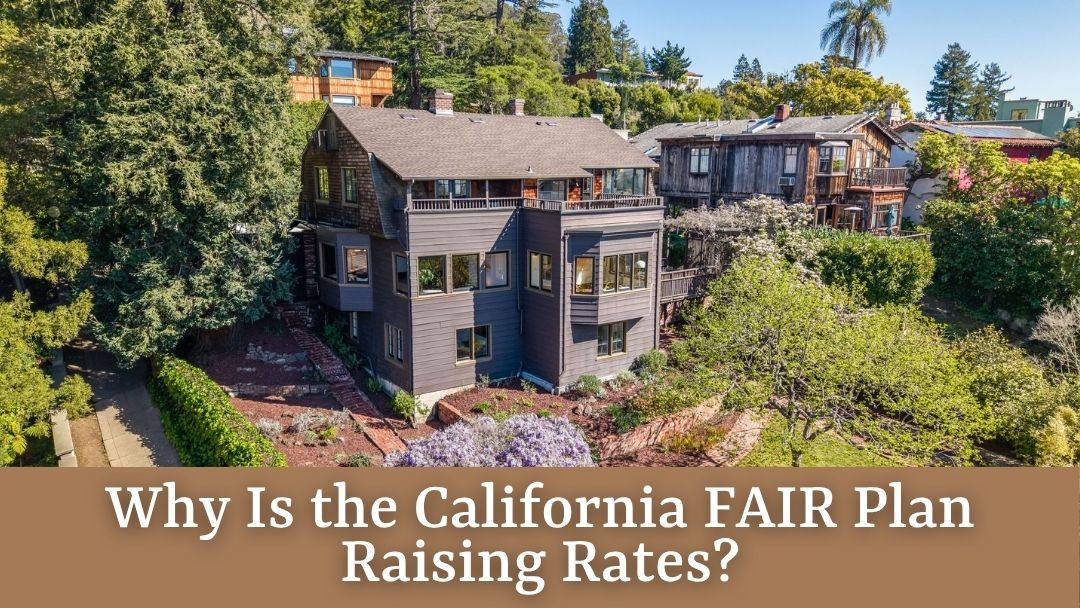
If you own a home in Berkeley and have been following California’s insurance market, you already know the headlines have not been easy to read. The California FAIR Plan, the state’s insurer of last resort, recently received approval for its largest rate increase in years. For many homeowners in our area, the practical question is the same: what does this mean for my policy, my budget, and my ability to sell or buy?
The answer requires some history, because what is happening right now is not simply a reaction to recent wildfires. It is the result of decades of regulatory policy colliding with a risk environment that policy was never designed to handle.
How a Safety Net Became a Primary Insurer
The California FAIR Plan was established in 1968 as a temporary safety net, intended to provide basic fire coverage to homeowners who could not obtain it in the private market until traditional coverage became available again. For most of its history, it operated quietly at the edges of the insurance market. That is no longer the case.
Exposure for residential dwellings under the FAIR Plan increased from $160 billion to $558 billion between 2021 and 2025. In 2009, just 7% of California ZIP codes had FAIR Plan policies accounting for more than 10% of the combined total of FAIR and admitted insurer policies. By 2022, that share had more than doubled to 22%, reflecting the expansion of the residual market as private insurers continued to retreat.
As of March 2026, the FAIR Plan had 684,388 active policyholders, a 6% increase since September 2025 and a 152% increase since September 2022. That is not a program operating as a last option. It has become a primary insurer for a very large and growing share of California homeowners, carrying exposure it was never designed to absorb at this scale.
The growth accelerated sharply after January 2025. The California FAIR Plan reported an estimated $4 billion in losses from the January 2025 wildfires, particularly from the Palisades and Eaton fires. To cover those losses, it assessed insurers $1 billion, half of which insurers may pass back to their customers in the form of increases.
To understand how the FAIR Plan arrived here, you have to understand the regulatory framework that pushed private insurers out of the market in the first place.
The Proposition 103 Problem
Before Proposition 103’s passage in 1988, California was an open-competition state in which market forces set insurance prices. The proposition rolled back then-current insurance rates by 20% and established strict requirements on rate setting. Championed as a consumer protection measure, it made the insurance commissioner an elected position and required prior approval of all rate changes before they could take effect.
For many years, in a relatively stable risk environment, the framework worked reasonably well. The problems emerged as wildfire risk grew faster than the regulatory system could accommodate. Prop 103 requires that all rate changes on property and casualty insurance lines be approved by the California insurance commissioner before being implemented, a process that can take months, resulting in significant rate suppression. When wildfire losses began accelerating sharply, insurers found themselves unable to get timely approval for rates that reflected their actual financial exposure.
The second structural problem was even more consequential. Prop 103 does not allow the use of forward-looking catastrophe models that integrate considerations of risk, exposure, and vulnerability based on more recently available data. Insurers have access to tools like advanced wildfire catastrophe models that would allow them to project future wildfire losses in ways that consider both changing climatic factors and a given property’s proximity to fuel load. Because those models largely did not exist in 1988, Prop 103 neither permitted nor explicitly barred them, but regulators treated them as outside the approved methodology.
The result: insurers could not price wildfire risk accurately, could not get rate adjustments quickly, and could not justify staying in high-risk markets. Under Proposition 103, insurance companies are legally free to choose where they write policies in California. As a result, they have been writing more and more in areas deemed less risky, which most affects residents in areas with wildfire risk where the California FAIR Plan has become the only option for insurance, rather than the last resort it was intended to be.
Rather than fix Proposition 103, California policymakers instead utilized the FAIR Plan as a public backstop. That decision set the stage for everything happening now.
Prop 103 is also remarkably inflexible: its provisions cannot be amended by the Legislature except by a statute passed in each house by a two-thirds supermajority, or by a statute approved by the electorate. Meaningful structural reform has remained politically and procedurally out of reach, which is why the state has worked around the edges rather than directly addressing the root cause.
The Sustainable Insurance Strategy: A Workaround Within the Rules
Commissioner Lara’s Sustainable Insurance Strategy, finalized in late 2024, represents the most significant regulatory shift California has made within the Prop 103 framework. For the first time, it allows insurers, including the FAIR Plan, to use forward-looking catastrophe models and to factor in reinsurance costs when setting rates. Neither was previously permitted under regulatory practice. The strategy also requires insurers that take advantage of these new tools to write more policies in wildfire-distressed areas, creating an incentive to return to markets they had abandoned.
Insurance Commissioner Lara has noted that FAIR Plan growth has slowed measurably over the last two quarters, coinciding directly with insurers filing and receiving approvals under the Sustainable Insurance Strategy. That is cautiously encouraging, though the path back to a fully functioning private insurance market in high-risk areas will be slow.
What the FAIR Plan Requested and What Was Approved
Following the January 2025 firestorms, the California FAIR Plan filed for a dwelling policy rate hike averaging 35.8%, which would have been its largest in years, topping increases of 20.3% in 2019 and nearly 16% in 2021 and 2023. The 2023 rate hike of 15.7% was itself cut down by Insurance Commissioner Ricardo Lara from the 48.8% originally sought by the plan.
This time, the Commissioner again trimmed the request. The California Department of Insurance approved a 29.1% rate increase, taking effect on all new and renewal business on October 15, 2026.
Critically, 29.1% is an average, and the actual impact on individual policyholders will vary significantly. The largest component of the increase relates to the wildfire portion of policyholders’ premiums, so those at significant wildfire risk will see higher increases than those at lower risk, and some policyholders will see a premium decrease. Homeowners in lower-risk areas could see smaller increases or even lower premiums than they pay today. In practice, properties in Berkeley’s hills and wildland interface zones are likely to see higher adjustments than those in the flats, where some policyholders may see their costs hold steady or fall.
Here is the critical piece of context: the FAIR Plan said it would have requested an 80% increase without the Sustainable Insurance Strategy reforms, which allow the FAIR Plan and other insurers to price wildfire risk using forward-looking models rather than relying solely on historical loss data. The 29.1% approved increase is not simply a post-fire rate correction. It is decades of suppressed pricing being brought into alignment with reality, and the Sustainable Insurance Strategy is the mechanism that kept it from being far worse.
What the 2025 Legislative Package Changes
Governor Newsom signed a package of stabilization measures in October 2025 that affects how the FAIR Plan operates going forward.
The FAIR Plan Stabilization Act (AB 226) permits the FAIR Plan to access debt financing if it is at risk of insolvency, allowing the California Infrastructure and Economic Development Bank to issue bonds on the FAIR Plan’s behalf to pay catastrophic claims. This means the plan no longer depends entirely on insurer assessments or rate hikes to survive a large loss event.
The Business Insurance Protection Act (SB 547) extends the protections homeowners receive after a fire, including a one-year prohibition of non-renewals from insurance companies, to businesses, homeowners’ associations, condominiums, affordable housing units, and nonprofits.
The Insurance and Wildfire Safety Act (AB 1) requires California’s insurance regulators to regularly review and update their regulations designed to promote wildfire safety and encourage insurers to offer discounts for wildfire mitigation.
None of these measures touches Prop 103 directly. They represent the state doing what it can within the existing constraints, making the FAIR Plan more financially durable and more accountable while the deeper structural issues remain unresolved.
The Wildfire Hardening Discount Program
One concrete piece of good news is the FAIR Plan’s Wildfire Hardening Discount program, available for policies with an effective date of November 15, 2025 or later.
The program allows policyholders to qualify for up to 12 separate discounts applied to the wildfire portion of their premium. Dwelling Fire policyholders who earn all 12 discounts could see savings of up to 16.4%. The discount categories cover immediate surroundings (clearing vegetation and combustible materials within five feet of the structure), structural features (ember-resistant vents, Class A fire-rated roofing), and community-level recognition through programs like Firewise USA.
The average annual FAIR Plan premium is around $2,800, but in the highest-risk zones, costs are substantially higher. After the 29.1% approved increase takes effect in October, a policyholder paying $2,800 today would see that rise to roughly $3,600 at the average rate, before any hardening discounts are applied. For properties in Very High Fire Hazard Severity Zones, premiums for a $400,000 dwelling commonly run between $3,200 and $4,800 per year, and a $1 million dwelling in a foothill county typically runs between $5,000 and $9,000 per year.
Pursuing eligible hardening improvements before your renewal date is a concrete way to offset some of this increase. For Berkeley homeowners in particular, steps like installing ember-resistant vent screens, creating defensible space around structures, and checking whether your neighborhood qualifies as a Firewise community are worth exploring. I have written about insurance replacement costs, BESO compliance and EMBER defensible space requirements in earlier articles on this site if you want more detail on what those improvements look like in practice.
What This Means for Buyers and Sellers
For anyone in a transaction right now, insurance disclosures and coverage availability need to be addressed early in the process, not at the last minute. If a property currently carries a FAIR Plan policy, the October rate adjustment will affect the buyer’s cost of ownership and needs to be reflected in their financial planning. Lenders will require proof of insurance, and if a buyer is relying on FAIR Plan coverage, they should understand that the policy is a bare-bones fire policy. A difference-in-conditions (DIC) wrap policy is typically required alongside it to provide broader coverage, typically running 25% to 60% of the FAIR Plan premium on top.
For sellers, documenting wildfire mitigation and other fire risk improvements made to the property has become increasingly important. Those improvements not only affect a buyer’s insurability but may also qualify the property for hardening discounts that make the overall insurance cost more manageable going forward, which is a meaningful selling point in a market where buyers are scrutinizing insurance costs carefully.
The window between now and October 15 is worth using. Homeowners on the FAIR Plan should talk to their broker about whether private market options have reopened for their property under the Sustainable Insurance Strategy. If private coverage is not yet available, the time to document mitigation work, explore hardening discounts, and understand your DIC wrap options is before the new rates take effect, not after.
I work closely with buyers and sellers navigating these questions every day and am happy to connect you with the right resources. If you have questions about how insurance conditions are affecting your specific property or a transaction you are considering, reach out directly.
Frequently Asked Questions
The California Department of Insurance approved a 29.1% average rate increase for the California FAIR Plan. The new rates apply to all new and renewal dwelling policies with an effective date of October 15, 2026.
Not necessarily. The 29.1% is an average across all policyholders. Because the increase is concentrated in the wildfire portion of the premium, homeowners in higher-risk areas will likely see larger increases, while those in lower-risk areas may see smaller increases or even a decrease in their premium.
The increase reflects two compounding factors. First, the FAIR Plan incurred an estimated $4 billion in losses from the January 2025 wildfires. Second, for decades Proposition 103 prevented insurers from using forward-looking catastrophe models to price wildfire risk accurately, resulting in rates that were suppressed well below what the actual risk warranted. The FAIR Plan has stated it would have requested an 80% increase without the Sustainable Insurance Strategy reforms that now allow forward-looking modeling.
Yes. The FAIR Plan’s Wildfire Hardening Discount program, available for policies with an effective date of November 15, 2025 or later, offers up to 12 separate discounts applied to the wildfire portion of your premium. Dwelling Fire policyholders who qualify for all 12 discounts can save up to 16.4%. Discounts cover vegetation clearing within five feet of the structure, ember-resistant vents, Class A fire-rated roofing, and participation in programs like Firewise USA.
A difference-in-conditions (DIC) policy is a supplemental policy that provides coverage the FAIR Plan does not, including water damage, theft, and liability. Because the FAIR Plan covers only basic fire perils, most lenders and insurance advisors recommend pairing it with a DIC wrap. DIC premiums typically run between 25% and 60% of the FAIR Plan premium, so the total cost of a complete insurance program is higher than the FAIR Plan premium alone.
For buyers, insurance costs need to be factored into affordability calculations from the start of the search, not at closing. If a property carries a FAIR Plan policy, the October 2026 rate increase will affect the ongoing cost of ownership. For sellers, documenting wildfire mitigation improvements is increasingly important, as those improvements can qualify the property for hardening discounts and make it more attractive to buyers who are carefully evaluating insurance costs.
Some admitted carriers are beginning to return to certain California markets under the Sustainable Insurance Strategy, which allows them to use forward-looking catastrophe models and factor in reinsurance costs when setting rates. Insurance Commissioner Lara has noted that FAIR Plan growth has slowed over the last two quarters, coinciding with new insurer filings and approvals under the strategy. Berkeley homeowners currently on the FAIR Plan should ask their broker whether private market options have reopened for their specific property.