
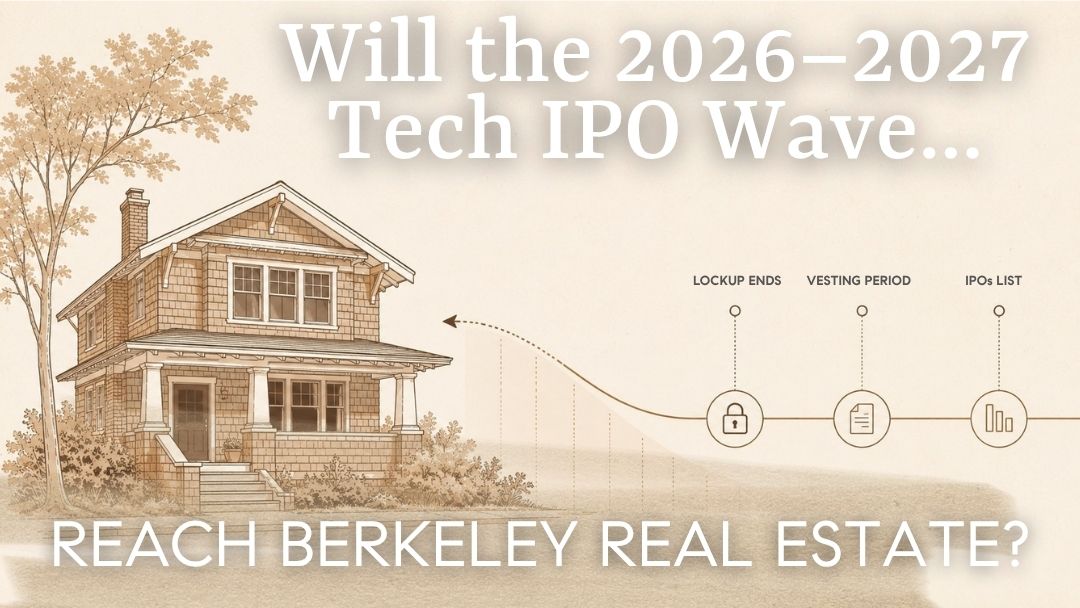
SpaceX, Anthropic, and OpenAI are heading to the public markets. Here is how and when that wealth might reach the Berkeley real estate market after a tech IPO and how I’d plan around it as a buyer or a seller.
Short answer
The largest IPO wave in a generation is moving through the public markets in 2026, but the date that matters for Berkeley housing is not the IPO — it is the lockup expiration roughly six months later, when employees can finally sell shares. That puts the real liquidity wave in 2027, and it reaches Berkeley as a spillover from San Francisco and the Peninsula, not a direct flood. The opportunity in the premium market (above $1.5M) is real but will lag the equity release, which means planning around the lockup calendar rather than the headlines.
When does IPO money actually reach the housing market?
Not on the day a company goes public. It reaches housing months later, when the lockup period expires. A lockup is a contractual restriction — typically 180 days after the listing — that prevents employees and insiders from selling their shares. Until it lifts, an engineer’s newly public stock is wealth on paper. They cannot turn it into a down payment or an all-cash offer.
So the headline I’d watch is not “Company X goes public.” It is “Company X’s lockup expires.” That is the moment stock grants and options become liquid, and it is the window when housing demand from any given IPO tends to rise. A few large issuers use staggered or shortened lockups — sometimes around 120 days, tied to the second earnings report — but the principle holds: plan around the lockup, not the IPO.
Which IPOs matter, and when do their lockups lift?
Three offerings dominate this cycle, and their size is genuinely without recent precedent. SpaceX is set to list on June 12, 2026. Anthropic filed confidentially on June 1, 2026, with an offering discussed as early as that fall. OpenAI filed on June 8, 2026 and is targeting late 2026, with some signals pointing into 2027. Together, these three could ask the public markets for more than $200 billion — against roughly $45 billion for all U.S. IPOs in 2025.
Translate those listing dates through a standard six-month lockup and the housing-relevant calendar comes into focus:
- SpaceX (mid-2026 listing) → first liquidity around late 2026.
- Anthropic (fall 2026, if it holds) → liquidity around spring 2027.
- OpenAI (late 2026 to early 2027) → liquidity around mid-2027.
This is why I describe it as a rolling wave rather than a single event. The leading edge arrives in late 2026, with the bulk of funds being unlocked across 2027, and continued vesting and secondary sales extend the effect into 2028. There is no one weekend when billions appear.
Does this money actually come to Berkeley, or stay in San Francisco and the Peninsula?
Most of it never touches Berkeley directly, and I think it’s worth being honest about that. The bulk of IPO proceeds flow to investors worldwide, not to local workers. Among the employees who do see a windfall, most work in San Francisco and on the Peninsula, so the first and strongest buying pressure historically lands there. Berkeley benefits through spillover — buyers priced out of the city or Peninsula, households wanting more space and character, and families looking for the better performing public schools of Berkeley.
The 2019 cycle is the most recent precedent we have. When Uber and Lyft went public, Redfin calculated that Uber employees alone could have bought every home then for sale in San Francisco, Oakland, and Berkeley — all 116 Berkeley listings, for about $165 million. The headline was spectacular. The result was not: brokers across the region reported a market that was no busier than the year before.
The gap between those two facts helps guide our expectations. Equity wealth is taxed heavily when it’s realized — combined federal and California rates can take roughly half of an option exercise — and it’s released slowly through vesting and trading windows. Only a fraction of newly liquid employees actually buy a home in any given year. The spillover into the East Bay is real, and analysts are actively debating its size, but it is a measured current, not a tidal wave. I encourage you to plan against the measured version.
Who is the Berkeley IPO-era buyer?
Not the 26-year-old engineer with a fresh windfall — that buyer usually purchases near the office, in San Francisco or down the Peninsula. The buyer who lands in Berkeley’s premium market skews older: a household in its late thirties to early fifties, often dual-career, frequently with one partner established at the university, a hospital, or a lab. They are choosing architecture, walkability, schools, and proximity to Cal over a glass tower near a campus shuttle.
That shapes what the equity wealth actually buys here. The money that finds Berkeley tends to come from founders and early employees diversifying out of a concentrated stock position — people who want a Maybeck brown shingle, a Julia Morgan-era home, or a fully electrified Craftsman, and who care that it’s done well. It is a more durable, less speculative cohort than the headlines imply, and it maps very closely to the homes I specialize in.
If you’re buying with equity wealth, how should you structure the move?
Start from your own lockup date and work backward — that’s the calendar your purchase really runs on. A few things I walk buyers through:
- Cash versus financing. In Berkeley’s premium tiers, a clean all-cash offer competes well, but you don’t have to wait for liquidity to act. Financing now and paying down (or recasting) after your lockup lifts is a legitimate approach and could put you ahead of the competition. Which is better depends on rates and your tax picture, which is a conversation for your lender and CPA before you write anything.
- Transfer-tax timing. Berkeley’s city transfer tax is currently 1.5% up to $1.6M and 2.5% above it, on top of the county’s $1.10 per $1,000. Higher tiers are scheduled to take effect January 1, 2027: 3% for homes at $1.9M or more, and 3.5% at $3M or more. That date sits squarely inside the lockup-driven buying window. On a $2,000,000 home, the city tax is $50,000 at today’s 2.5%, and $60,000 once the 3% tier applies — a $10,000 swing that turns on which side of January 1, 2027 you close. The convention in Berkeley is that buyers and sellers split the city transfer tax fees, but like any real estate transaction, everything is negotiable, which makes it worth raising early.
- Realizing the stock is a taxable event. Exercising options or selling RSUs to fund a purchase generates a tax bill in the same year. Model your net-of-tax proceeds, not your headline number, and coordinate the timing with your CPA before you set a budget. I’ll help you sequence the home search around it; I’ll leave the tax mechanics to your advisor.
If you’re selling, should you wait for the wave?
Maybe, but preparing in advance is always prudent. Premium Berkeley inventory is limited, and homes with character are exactly what diversifying buyers come looking for, so if the spillover materializes in 2027 it may favor well-prepared sellers of architecturally significant and energy-efficient homes. That’s a real tailwind worth positioning for.
What I wouldn’t do is hold a sale hostage to an uncertain future event. The wave depends on lockup dates that can slip, listings that may price below expectations, and a spillover share no one can guarantee. I price and time listings against current Berkeley data, not a speculative forecast. I track absorption in the above-$1.5M segment quarter by quarter, and I’m glad to model your specific window — what’s selling, at what sale-to-list, and how a 2026 sale compares to waiting for 2027 — so you can make an informed decision that is grounded in actual data.
Frequently asked questions
Common questions about the tech IPO wave and Berkeley real estateMostly in 2027, not 2026. The wealth from an IPO becomes spendable when the lockup period expires — typically about 180 days after a company lists — so the housing effect lags the listing by roughly six months. With SpaceX listing in mid-2026 and Anthropic and OpenAI expected to follow into late 2026 and early 2027, the bulk of liquidity lands across 2027, with continued effects into 2028.
A lockup is a contractual restriction that prevents company employees and insiders from selling their shares for a set time after the IPO — most commonly 180 days. Until it expires, newly public stock is wealth on paper that cannot be converted into a down payment or an all-cash offer. The lockup expiration, not the IPO date, is the moment that matters for real estate planning.
Some will, but Berkeley sees this wealth mainly as a spillover from San Francisco and the Peninsula, where most of these employees work and first look to buy. The buyers who reach Berkeley’s premium market tend to be older, often dual-career households — frequently founders or early employees diversifying a concentrated stock position — who are drawn to the city’s historic and sustainable homes rather than proximity to a campus.
Far less than the headlines predicted. In 2019, Redfin calculated that Uber employees alone could have bought every home then for sale in San Francisco, Oakland, and Berkeley in cash. Yet brokers across the region reported a market no busier than the prior year. Heavy taxes on realized equity, slow vesting, and the fact that only a fraction of employees actually buy all blunt the translation from paper wealth to home purchases.
Berkeley’s city transfer tax is currently 1.5% up to $1.6 million and 2.5% above that, plus the county’s $1.10 per $1,000. Higher tiers are scheduled to take effect January 1, 2027: 3% for homes at $1.9 million or more, and 3.5% at $3 million or more. On a $2,000,000 home, that is $50,000 in city tax today versus $60,000 once the 3% tier applies. Who pays the tax is negotiable and often split between buyer and seller. Confirm current rates with the City of Berkeley before closing.
It depends on your home and your timeline, and it’s worth modeling rather than assuming. Thin premium inventory and strong demand for character homes could favor well-prepared sellers if the 2027 spillover materializes, but lockup dates can slip and the spillover’s size is uncertain. The sound approach is to price against current Berkeley data and absorption in the above-$1.5M segment, then weigh a 2026 sale against waiting for 2027 on the numbers.
This information is general and current as of June 2026. IPO timelines, tax rates, and market conditions change; confirm current figures and consult a CPA or financial advisor before making decisions.